Posts

Showing posts with the label Sir Walter Raleigh

Of cups and plate Pt 2

Image
Fairlynch Museum Trustee Michael Downes, left, with  David Williams holding the replica chalice. In the background is the copy by Budleigh Salterton Venture Art Club of Millais' famous painting 'The Boyhood of Raleigh.' The Museum displayed the original painting on two occasions in the past David Williams, Managing Director of Birmingham-based  pewterers  takes us through the design and manufacturing process involved in Fairlynch Museum’s replica of the All Saints Church chalice designed by Exeter goldsmith John Jones in the 1570s. “Our approach to producing this chalice makes for an interesting story itself,” says David. “But making it was not easy. Because of the value of the chalice, we could only work from measurements and photos and were not able to make a mould directly from it. The measurements of the original were taken by Fairlynch Museum Chairman, Trevor Waddington, who was also involved in the project.”   "We arranged for the lid to be ...

Musings at the Museum

Image
Sixty children from Awliscombe C of E Primary School came to visit Fairlynch to celebrate the end of term. They met Jack Rattenbury in the Smugglers’ Cellar.  “Is he dead?” they asked, feeling his cold and clammy fingers. Do they mean the 19th century smuggler or the eerily lifelike figure with piercing brown eyes and computer-generated voice? Who knows what kids think? Do they want to be reassured? Do they suspect there are more Jack Rattenburys out there in Lyme Bay ?   Is she nervous of him, or a bit uncertain of the photographer?  After some explanation they thought that he was probably ok. Dangerous though. A smuggler. “Yes, he did escape from the police. Yes, he probably was violent.”      Sir Walter Raleigh was not so frightening. “Or could that be the man on the bonfire? A penny for the guy, a penny for my thoughts. Were those barrels of gunpowder in the Smugglers’ Cellar?   Was there a candle...

City of Gold

Image
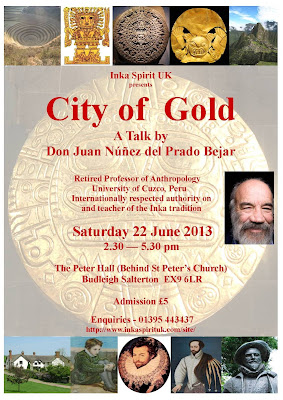
    Ancient traditions of the Inka Empire will be the subject of a talk being given in Budleigh Salterton on Saturday 22 June.   Retired anthropology professor Don Juan Núñez del Prado Bejar has devoted over 30 years to studying the spiritual practices of the Q’ero Indians, an indigenous people living in a remote area of Peru . It was Don Juan’s father, anthropologist Oscar Núñez del Prado, who brought the Q’ero to the world’s notice following a 1955 expedition to the Peruvian Andes.   The Q’ero see themselves as the last living descendants of the Inka people, believing that their ancestors fled to the mountains of Peru at the time of the Spanish conquest in the 16th century. Here, explains Don Juan, they maintained the Andean philosophy which, like Buddhism, argues that everything – from solid matter to living beings – is made up of living energy. Like the Spanish conquistadores, our own Sir Walter Raleigh, born in East Budleigh, was tempted to ex...

Happy Independence Day

Image
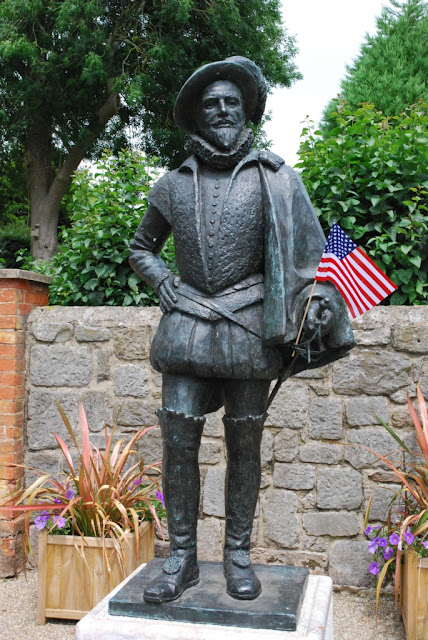
From his birthplace in East Budleigh, Devon , Sir Walter Raleigh wishes his American friends across the Pond "A Happy Independence Day." A Raleigh corner is one of the permanent displays in Fairlynch Museum . We are only a few doors away from The Octagon, the building where Sir John Millais stayed when working on his famous painting 'The Boyhood of Raleigh.' A blue plaque commemorates the artist's stay in Budleigh Salterton.   Across the Pond the state capital of North Carolina and its second largest city was named Raleigh in 1792 to honour Sir Walter, sponsor of the Roanoke Colony. A bronze statue, which has been moved around different locations within the city, was made in honour of the city's namesake. There's even a neighbourhood in the city of Raleigh called Budleigh. The 'Lost C...