Posts

Showing posts with the label science

In praise of Admiral Preedy
Image
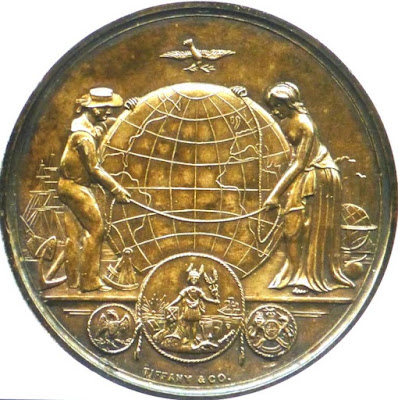
This gold medal was issued by the New York-based Tiffany & Company to celebrate the achievement of those who had laid the first transatlantic telegraph cable in 1858, including former Budleigh resident Admiral Preedy CB (1817-94). I thought I would add my own bloggerel contribution to mark the Admiral's bicentenary in 2017.  It can be sung to the tune of ‘Miss Lucy had a baby’. 1. Now let us sing of heroes, who sailed the ocean blue, And of a Budleigh worthy, and don’t forget his crew. Two hundred years ago it was - from rural Worcestershire - That Georgie William Preedy came: A nautical high-flier. He passed all his exams, of course, and rose up through the ranks.   We’re sure that to an army life he would have said ‘No thanks!’ Chorus So let us raise our glasses to our Admiral Preedy! This year is very special as his bicentenary. HMS Agamemnon , launched...
Budleigh Salterton scientist Henry Carter and that dinosaur poo

Image
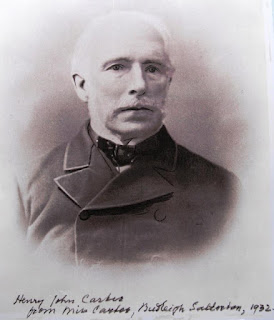
At a previous post about Fairlynch’s Object of the Month for April 2016 I promised that I would give some background to my pooem at http://budleighbrewsterunited.blogspot.co.uk/2016/04/fairlynch-museums-object-of-month-for.html   No, it wasn’t an April Fool. A few years ago I wrote the first biography of any length devoted to the life and achievements of Henry Carter FRS, physician, geologist and naturalist, pictured above.  Born in Budleigh Salterton, Carter returned to his “native place” as he calls it in 1862 after travels in Arabia and working as a doctor in India . He is buried in the churchyard of All Saints, East Budleigh . Carter was internationally known by his contemporaries for his research into marine sponges, but it was for his work as a geologist that the Royal Society elected him as a Fellow in 1859. There is evidence to show that his geologising had begun while he was still a boy, as he explored ...

From slavery to sponges: imagining conversations in Victorian Budleigh Part 2

Image
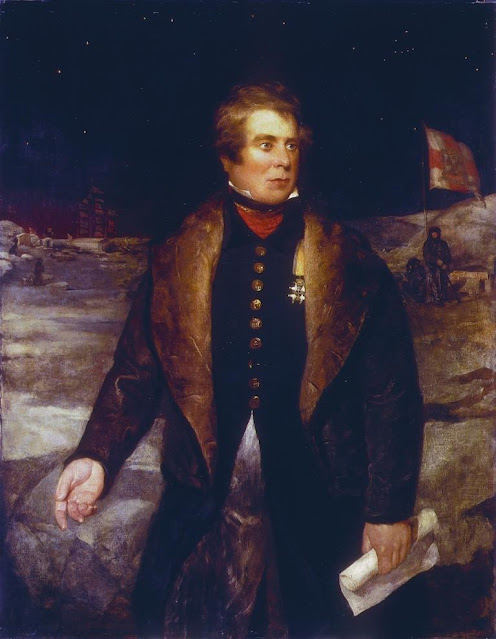
Continued from   https://budleighpastandpresent.blogspot.com/2015/10/from-slavery-to-sponges-imagining.html It seems that John Campbell, the wealthy Budleigh resident and benefactor of Henry John Carter, the future FRS, took a keen interest in the voyages undertaken by adventurers of his time.  Admiral Sir John Ross By an artist of the British school, 19th century  He would probably have read the 740-page volume written by a fellow-Scot who had made his name as an explorer. This was Captain, later Admiral, Sir John Ross (1777-1856), pictured above;  the account of his adventures was entitled Narrative of a second voyage in search of a North-West passage, and of a residence in the Arctic Regions during the years 1829, 1830, 1831, 1832, 1833. The book was published by the London firm of A.W. Webster in 1835, and John Campbell’s name is on the List of Subscribers to the companion Appendix which app...

People from the past 10: Valerie Dwerryhouse (1933-2010)

Image
Valerie Dwerryhouse: admired by colleagues for her work behind the scenes at Fairlynch Museum  Over the years Fairlynch has been fortunate in finding many volunteers with a professional background in research, enabling the Museum to maintain high standards normally found in much bigger institutions. The good scientist’s ability to think critically is of special value and Dr Valerie Dwerryhouse, a highly respected immunologist and Fairlynch volunteer for many years, was certainly distinguished in that respect. She was born Valerie Stacey on 17 September 1933. Brought up in the village of Holsworthy, in north-west Devon, she studied Microbiology at Imperial College after graduating in Household and Social Science at London University’s Queen Elizabeth College. Some of the inspiration and motivation for her studies came from the family doctor in Holsworthy, Stuart Craddock, who had been a research assistant to Sir Alexand...