Posts

Showing posts with the label sponges

From slavery to sponges: imagining conversations in Victorian Budleigh Part 2
Image
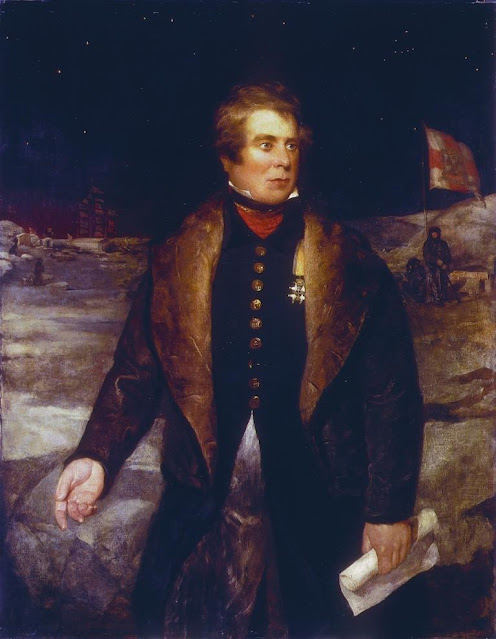
Continued from   https://budleighpastandpresent.blogspot.com/2015/10/from-slavery-to-sponges-imagining.html It seems that John Campbell, the wealthy Budleigh resident and benefactor of Henry John Carter, the future FRS, took a keen interest in the voyages undertaken by adventurers of his time.  Admiral Sir John Ross By an artist of the British school, 19th century  He would probably have read the 740-page volume written by a fellow-Scot who had made his name as an explorer. This was Captain, later Admiral, Sir John Ross (1777-1856), pictured above;  the account of his adventures was entitled Narrative of a second voyage in search of a North-West passage, and of a residence in the Arctic Regions during the years 1829, 1830, 1831, 1832, 1833. The book was published by the London firm of A.W. Webster in 1835, and John Campbell’s name is on the List of Subscribers to the companion Appendix which app...

Budleigh’s sponge expert on show at NHM

Image
  Research on Budleigh Salterton's 19th century sponge expert by Fairlynch volunteer Michael Downes has helped curators prepare an exhibition at London's Natural History Museum.  Above: The feature on Henry Carter FRS in the Natural History Museum's display 'Untold Human Stories from the NHM Porifera Collection.'  Budleigh Salterton’s only native-born Fellow of the Royal Society Henry Carter was the main subject of the 2013 Fairlynch exhibition ‘Sea, Salt and Sponges.’     The exhibition was accompanied by a booklet ‘The Scientist in The Cottage’, written by Fairlynch Museum Secretary Michael Downes. It was praised by the NHM’s Emma Sherlock, Curator in the Invertebrate Section of the Zoology Department at the Museum, and is the first-ever published biography of the Budleigh-born surgeon, geologist and spongologist.  Emma explained that the booklet had helped in a project that she and her NHM colleagues...

Art meets Science at Fairlynch

Image
  The sponge Clathrina Coriacea (Montagu, 1818) was greatly admired by Henry Carter Image credit Fiona Crouch, Marine Biological Association of the UK There’s an awful lot of science in Fairlynch’s 2013 exhibition ‘Sea, Salt and Sponges.’ There’s fearsome-looking medical equipment, a fine display of microscopes and much information about the geology of places ranging from India to Canada , not forgetting Devon of course. Not to mention the surprisingly intricate anatomy of sponges with all those complex chemicals that they produce which are providing useful weapons in the war against cancer and other diseases. But Budleigh scientist and FRS Henry Carter (1813-95) whose bicentenary the Museum is celebrating was an artist in his way. He often shows himself in his writings charmed by the beauty of the marine species that he examined. Of the sponge Clathrina Coriacea (Montagu, 1818), pictured above, which he found on Budleigh beach he wrote “I t veils the dark rock benea...

The Scientist in The Cottage

Image
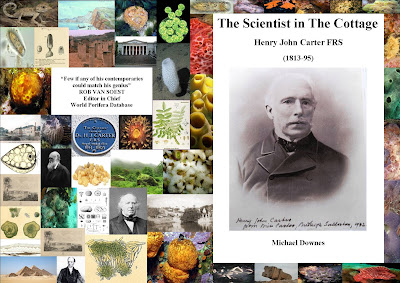
Museum visitors are often keen to take away a souvenir of an exhibition. This 40-page booklet is an informative guide to the life and achievements of Budleigh scientist Henry John Carter FRS, the main subject of Fairlynch Museum ’s 2013 exhibition ‘Sea, Salt and Sponges.’ Based largely on material from 19th century journals it offers some interesting insights into the Victorian era in which he lived.    There are sections on Carter’s medical career, on his time in southern Arabia , his work in geology and especially his research into sponges for which he is justly celebrated. Much admired by Darwin for his research Carter returned to his home town of Budleigh Salterton after twenty years as a doctor in India . He settled in the family home of The Cottage on Fore Street Hill, better known today as Umbrella Cottage. With a useful timeline to Carter’s life and fascinating images, many in colour and never previously published, the booklet written by Fairlynch Museum’s...